Biographies of Anselm and Henry of Ghent
(c. 1033-1109) and (c. 1217-1293)
Anselm (c. 1033-Aril 21, 1109)
Anselm, archbishop of Canterbury, was born at Aosta in Piedmont. He came from money—— a noble family with property.
His mother having filled Anselm with a love of religion dying when he was fifteen, and his father becoming increasingly violent, he encouraged himself to travel. He headed north across the Alps to France, eventually arriving at Bec in Normandy, where he studied under the eminent theologian and dialectician Lanfranc. He was a monk at the age of 27.
In 1063, Anselm was chosen to be prior. He instructed the monks, but still practiced tough spiritual exercises.
In 1070, Anselm began to write, particularly prayers and meditations, which he sent to monastic friends and to noblewomen. He also engaged in a great deal of correspondence, leaving behind numerous letters. Eventually, his teaching and thinking culminated in a set of treatises and dialogues. In 1077, he produced the Monologion, and in 1078 the Proslogion. Anselm wrote the De Veritate (On Truth), De Libertate Arbitrii (On Freedom of Choice), De Casu Diaboli (On the Fall of the Devil), and De Grammatico. Anselm was elected abbot of the monastery.
In 1092, Anselm traveled to England, where Lanfranc had previously been arch-bishop of Canterbury. The Episcopal seat had been kept vacant so King William Rufus could collect its income, and Anselm was proposed as the new bishop, a prospect neither the king nor Anselm desired. Eventually, the king fell ill, changed his mind in fear of his demise, and nominated Anselm to become bishop in 1093. In addition to the typical cares of the office, his tenure as arch-bishop of Canterbury was marked by nearly uninterrupted conflict over numerous issues with King William Rufus, who attempted not only to appropriate church lands, offices, and incomes, but even to have Anselm deposed. While archbishop in exile, Anselm finished his Cur Deus Homo, also writing the treatises Epistolae de Incarnatione Verbi (On the Incarnation of the Word), De Conceptu Virginali et de Originali Peccato (On the Virgin Conception and on Original Sin), De Processione Spiritus Sancti (On the Proceeding of the Holy Spirit), and De Concordia Praescientia et Praedestinationis et Gratiae Dei cum Libero Arbitrio (On the Harmony of the Foreknowledge, the Predestination, and the Grace of God with Free Choice).
After William Rufus's death, Anselm returned. Henry I also gave him a hard time. Anselm died in 1109. He was declared a doctor of the Roman Catholic Church in 1720, and is considered a saint by the Roman Catholic Church and the churches in the Anglican Communion.
Anselm is considered one of the originators of Scholasticism, a kind of scholarship where reason is subjugated to faith. Anselm is most well known for his Proslogion proof for the existence of God—— the ontological argument: God is that being than whom none greater can be conceived. Now, if that than which nothing greater can be conceived existed only in the intellect, it would not be the absolutely greatest, for we could add to it existence in reality. It follows, then, that the being than whom nothing greater can be conceived, i.e. God, necessarily has real existence (Sadler).
Henry of Ghent (c. 1217-1293)
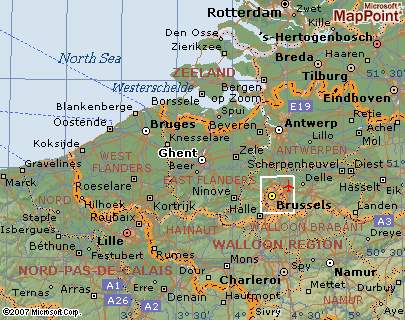
Henry of Ghent, also known as Doctor Solemnis (The Solemn Doctor), was a philosopher and theologian at the height of scholasticism. He was born at Ghent in Belgium and died in Paris or Tournai. He was called also Henricus de Muda or Mudanus or ad Plagam, probably from his place of residence in the town of Tournai, where he lived in 1267 as a secular priest and canon. He was a scholastic philosopher and theologian during the golden age of Scholasticism, a period full of intense intellectual activity closing the thirteenth century.
By 1276, the date of his first disputatio de quodlibet, he is Archdeacon of Bruges, and a few years subsequently he is Archdeacon of Tournai.
He taught initially in the Faculty of Arts in Paris before 1276 and subsequently in the Faculty of Theology in Paris from 1276 until his death.
In 1277 he was a part of the commission of theologians which assisted Stephen Tempier, Bishop of Paris (Copleston, 465).
In 1277 he also received the degree of Magister or Doctor of Theology. In 1282 he—— with two others—— was selected by Martin IV to arbitrate in the dispute about the privileges of the mendicant friars in regard to hearing confessions: he defended the rights of the bishops as against St. Bonaventure and the regulars.
Recent researches have debunked previous biographical thought about Henry; that he was a Servite or at least a member of some religious order.
His two greatest works, the "Quodlibeta" and the "Summa Theologica", indicate his preference for psychology and metaphysics.He was also a major influence on medieval thought by mixing Platonism with Aristotelian and Augustinian thought (Coffey).
REFERENCES:
Anselm (Archbishop). http://www.1911encyclopedia.org/Anselm_(Archbishop). Page last modified 1 Sep. 2006.
P. Coffey, transcribed by Diane E. Dubrule. Henry of Ghent. The Catholic Encyclopedia: Volume VII. Published 1910. New York: Robert Appleton Company. Nihil Obstat, June 1, 1910. http://www.newadvent.org/cathen/07235b.htm. Page last modified 2007.
Copleston, SJ Frederick. History of Philosophy vol. II. "Mediaeval Philosophy: Augustine to Scotus"
The Newman Press. Paramis, NJ 1966.
Sadler, Greg. The Internet Encyclopedia of Philosophy. http://www.utm.edu/research/iep/a/anselm.htm#H1
(also: http://www.unca.edu/philosophy/henryofghent.html)
Site Last Updated: 11/28/2007