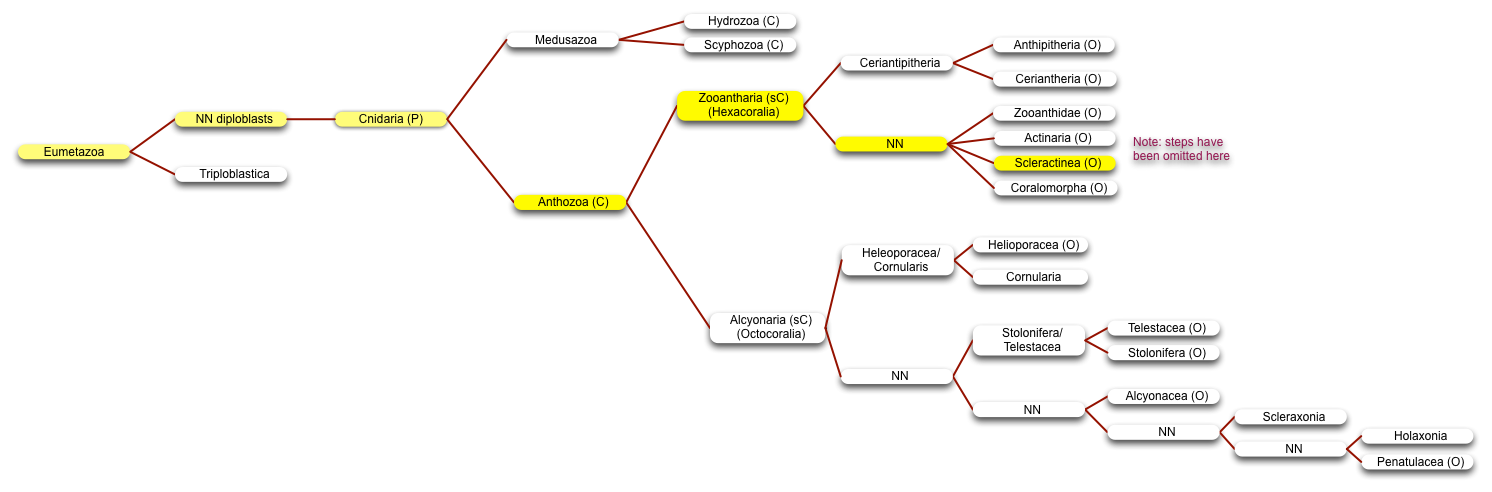
Class Anthozoa Exclusively marine solitary or colonial Cnidarians in which the medusoid stage is completely absent and the polyp complex with a septate gastrovscular cavity (Sea anemones, hard corals soft corals gorgonians and and sea pens.)
Subclass Zooantharia* (Hexacorallia)* Exclusively marine solitary or colonial polypoid (Polyps with more than eight tentacles and mesenteries, the latter typically in cycles of 12)
Ceriantipitheria
- Order Antipatharia* (Black or thorny corals. Georgonian-like species with an upright plant-like colonies. Polyps arranged around an axial skeleton composed of a black horny material and bearing thorns. Largly in deep water tropical seas. Antipathes*)
- Order Ceriantharia* (Tube anemones Anemone-like anthozoans with greatly elongate bodies adapted for living in secreted tubes buried in sand or mud. Aboral end lacks pedal disk. Arachnanthus, Botruanthus, Ceriantheomorphe, Ceriantheopsis, Cerianthus)
No name sister taxa to the ceriantipitheria
- Order Zooanthidea* (Small anemone-like anthozoans having one siphonoglyph and no skeleton. Solitary or colonial. Palythoa*, Zoanthus*, Epizoanthus, Parazoanthus)
- Order Actiniaria* (Sea anemones. Solitary anthozoans with no skeleton, with mesenteries in hexamerous cycles, and usually with two siphonoglyphs. Halcampoides, Edwardsia, Metridium*, Ephiactis, Stichodactyla)
- Order Scleractinia* (Stony corals. Mostly colonial anthozoans secreting a heavy, external, calcareous skeleton. Sclerosepta arranged in hexamerous cycles. Fungia*, Acropora*, Porites*, Astrangia*, Oculina*)
- Order Corallimoraria* (Solitary species with radially arranged tentacles. Resemble true corals but lack a skeleton. Corynactis, Rhodactis, Ricordia* Riccia*)