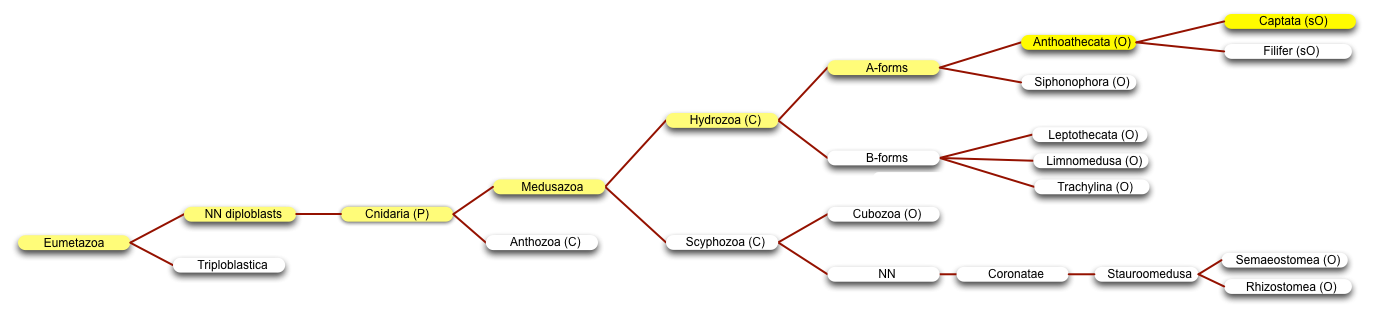
Class Hydrozoa* Hydroids - Cnidarians with simple medusa and a usually dominant polyp
A forms Atheacate polyps budding from axial polyps, tall medusa with oceli and manubrial gonads
- Order Anthoathecate (Anthomedusa)* Mostly cononial A form hydroids. Skeletal covering when present does not surround the hydranth. Free medusa which are tall and bell shaped, are commonly present. Bougainvilla, Calycopsis, , Pennaria*, Syncoryne, Eudendrium,, Polyorchis, and Hydra)
- Suborder Capitata Tentacles capitate or with a swollen knob terminus. High nematocyst concentration. Includes the stinging, or fire, coral. Skeleton covered by only by a thin epidermal layer. Tubularia, Millipora* Polyorchis*
- Suborder Filifera Tentacles filiform- no swelling Hydractinia, Bougainvilla, Clavia, Pennaria*, Syncoryne, Eudendrium,, Stylastulina
- Order Siphonophora* (Pelagic Hydrozoan colonies of both polypoid and medusoid individuals. Colonies with floats or large swimming bells. Largely in warm seas, Most have a gas filled flotation zoic. (Physalia*, Stephalia, Nectalia)
- Order Chondrophora Enigmatic group either colony or highly specialized individual. Polypoids attached to a multi chambered chitinous float. Pelagic; (Velella, Porpita)
L forms theacate or reduced growth by fixed length budding, short flat medusa with statocysts
- Order Leptothecatae* (Leptomedusa). Polyps always colonial, Hydranth surrounded by a skeleton. Free medusa are commonly absent, but when present are more or less flattened. Abietinaria, Aequorea, Bonneviella, Cuvieria, Eucheilota, Lovenella, Lytocarpus, Obelia*, Plumularia*, Sertularia*, Campanularia*, Abietinaria, Aglaophenia)
- Order Limnomedusa* Life cycle with both polyp and medusa, cup-shaped medusa dominant. Inconspicuous athecate polyp usually solitary Gonionemus*
- Order Trachymedusa* (Medusoid hydrozoans lacking a polypoid stage. Medusa develop directly from an actinula. Liriope, Aegina, Botrynema, Craspedacusta, Gonionemus*, Polypodium, Rhopalonema, Solmissus.)