ART 208
Introduction to Sculpture
Project #1: Monolithic Form
Assignment: Make six models in oil clay. Three should engage monolithic effects
and three should engage multilithic effects. Choosing one of your three monolith
models, make 3 more focus models that explore other variation possibilities. From
those focus models carve a full scale monolithic sculpture in foam. Link your expressive
intentions with the way you handle specific elements of your sculpture ( contour,
composition, massing, gesture, visual focus etc.)
Definitions: A monolith is, strictly speaking, a form consisting of a single
stone (mono = one, lith = stone). A multilith is a form made from a number of parts.
These two form types might simply refer to the way a thing is constructed; is it
carved from one mass or is it an assemblage of many? But we are more concerned with
the visual effect and meaning of these two opposite forms types. By visual analysis
of historical examples and by sketching directly in oil clay, you should become familiar
with how to create a sculpture with monolithic or multilithic effects.
Monolith-
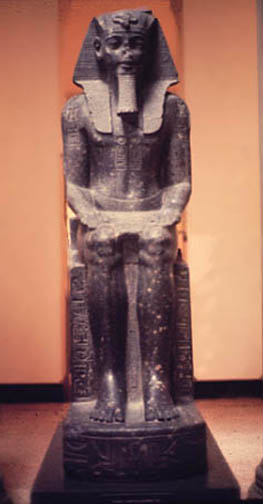
Slide example: Amenhotep III, New Kingdom, Egyptian, 1397-1360 BC
 Qualities
or meanings expressed:
Qualities
or meanings expressed:
1. A sense of permanence
2. Singularity/ absolute focus
3. Irreducibility
4. Unity through sameness
How the form achieves these qualities:
1. A sense of the block
2. A contour that contains (no intrusions of negative space or extensions into environment)
3. Equal distribution and emphasis of parts
4. Symmetrical composition creating a central focus
5. Minimizing differences
6. Static composition (the effect of perpendicular structuring)
Multilith-
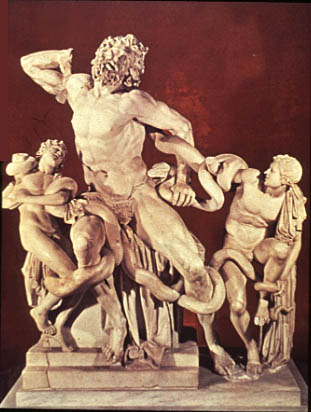
Slide example: "The Laccoon", Greek, Hellenistic, Late 2nd c. BC
 Qualities
or meanings expressed:
Qualities
or meanings expressed:
1. Struggle
2. Confusion
3. Power through movement
4. Difference/ conflict
How the form achieves these qualities:
1. Mass is dispersed
2. Contour acts to break up the form into discrete parts
3. Complexity/ multiplicity of parts (no apparent ordering system)
4. Decentralized, asymmetrical composition
5. Maximizing differences
6. Rapidly shifting focus ( eye moves rapidly from part to part).
Other Slide examples:
Form as singular contrasted to form as multiple. Note how detail in the monolith
has been reduced to create an essentialized single object and how the multilith is
based on a part to part relationship.
Monolith example: A. Archipenko, "Lean Torso", 1914 Multilith example;
J. Lipschitz, "The Guitarist", 1918
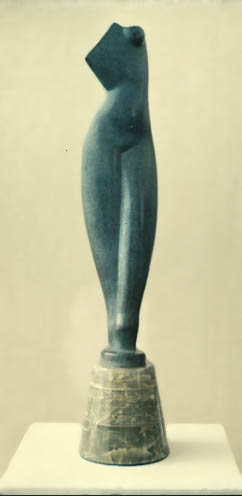
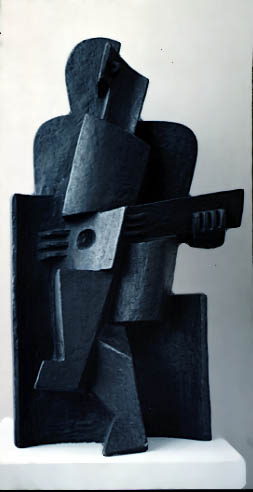
Articulation of the joints between forms. Both works seem to have parts but observe
the difference in how the connective details are handled.
Monolith example: R. Therrien, "No Title",
1983 Multilith example: Brancusi, "Adam
and Eve", 1922
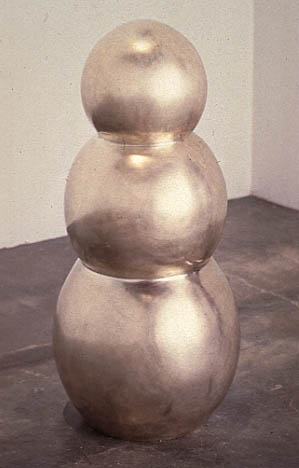
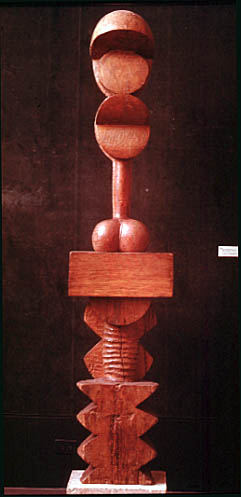
Again, note how connective detail are detailed. In the monolith example the shapes
are distinct but are locked together. In the multilith example the shapes barely
touch and look not even connected.
Monolith example: W. Kelly,"Arrested
Action", 1932 Multilith example: D. Smith,
"Cubi XII", 1963
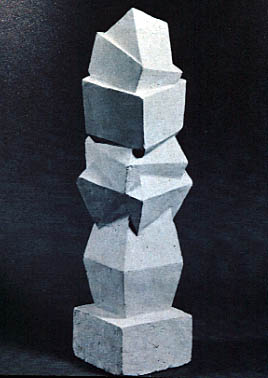
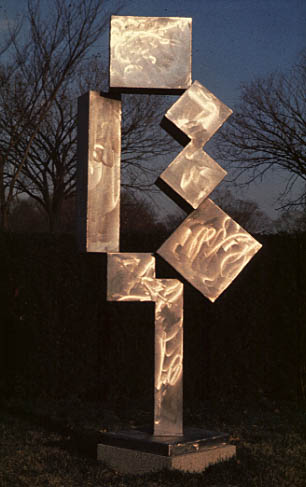
The effect of contour. In the monolithic example, the contour (outside edge of the
sculpture) seems to contain the form. In the mutilith example deep cuts invade the
interior space and act to break up the form.
Monolith example: J. Lipschitz, "Seated Bather", 1917 Mutilith example: S. Lipton, "Swing Low", 1942
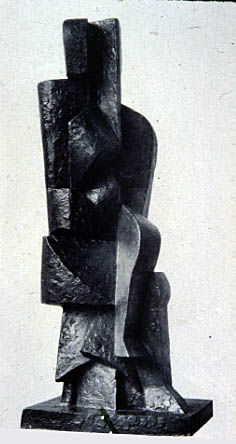
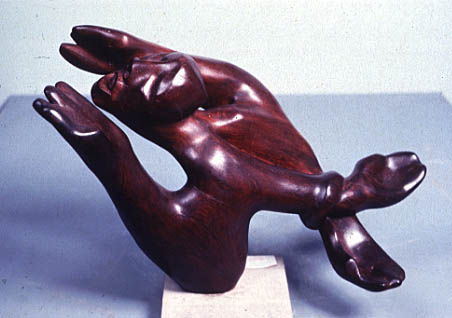
Monolith example: J. Storrs, "Architectural
Form", 1932Mutilith example: J. Arp,"Growth",
1938
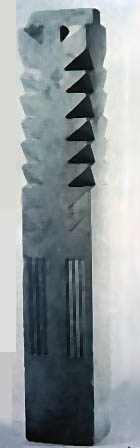
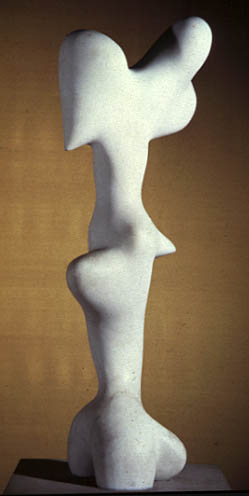
In the monolith example, the effect of a flowing, continuous contour acts to unify
and centralize your gaze toward a singular wholeness. In the multilith example, the
work appears area oriented. You focus on local areas before you see it as a whole.
Monolith example: A. Archipenko, "Seated Black Concave", 1916 Mutilith example: H. Matissee, "Seated Nude I",
1907
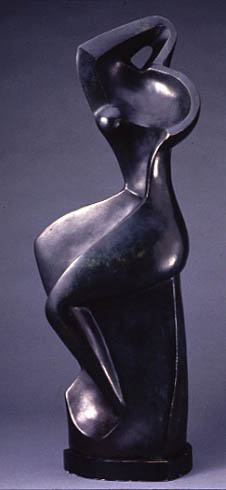
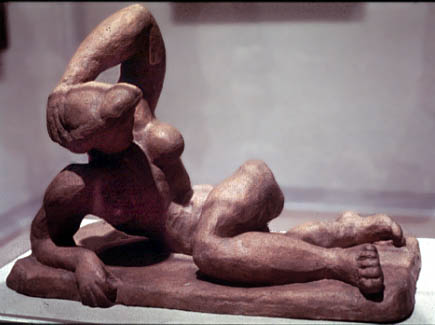
Again, the same type of example as above but with two abstract works. Notice how
your eye continues around the monolith while the deep intrusive cuts into the contour
of the multilith tends to trap your gaze.
Monolith example: J. Arp, "Configuration
in Serpentine"Mutilith example: M. Kendrick,
"Fine Piece", 1984
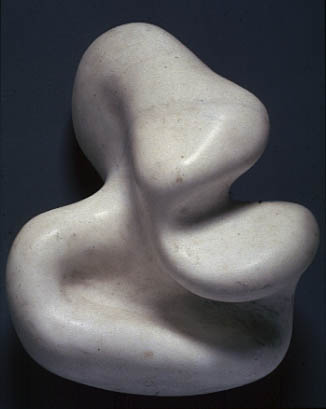
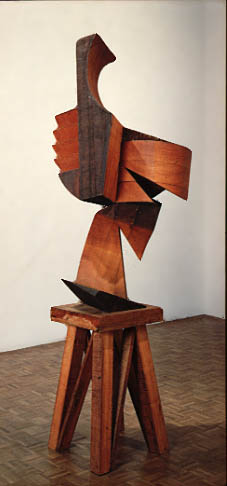
In the monolith example, parts do not seem multiple because they are made into a
great wholeness thru repetition. In the multilith example, parts are not organized
and therefore appear as diverse elements.
Monolith example: I. Noguchi, "Endless Coupling",
1954 Mutilith example: I. Noguchi, "Cronos",
1949
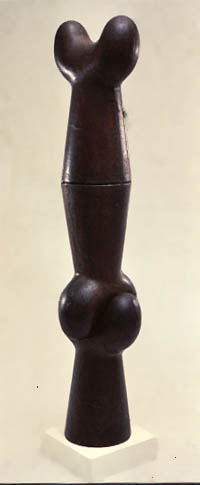
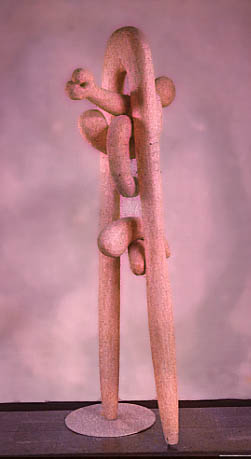
In the monolith example, symmetry holds your gaze with its centralizing focus and
creates the sense of sameness. In the multilith example, imbalance heightens a sense
of difference in the work.
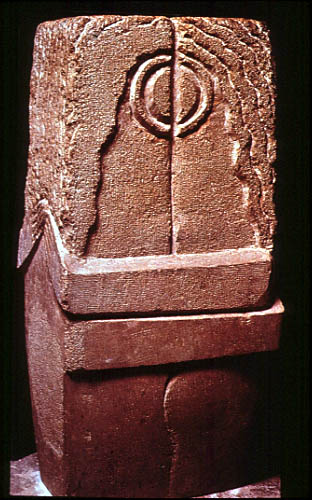
Monolith example: C. Brancusi, "The Kiss",
1910Mutilith example: I. Noguchi, "The
Cry", 1959